Basic life support is an emergency life-saving procedure that consists of recognizing and correcting failure of the respiratory or cardiovascular systems.
Basic life support comprises the “ABC” steps, which concern the airway, breathing, and circulation respectively.
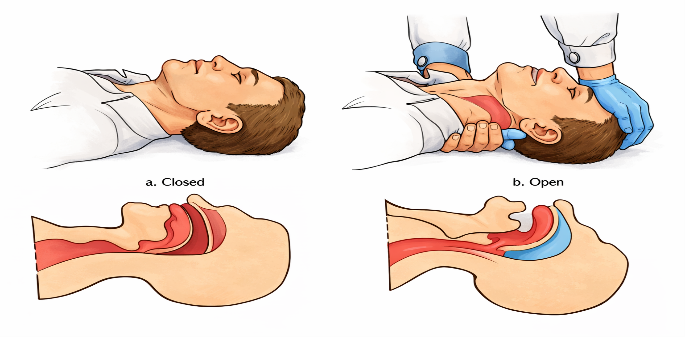
Airway (Step A): Establishing an open airway is the most important step in artificial respiration. Spontaneous breathing may occur as a result of this simple measure. Place the patient in a face-up position on a hard surface. Put one hand beneath the patient’s neck and the other hand on his forehead. Lift the neck with the one hand, and apply pressure to the forehead with the other to tilt the head backward
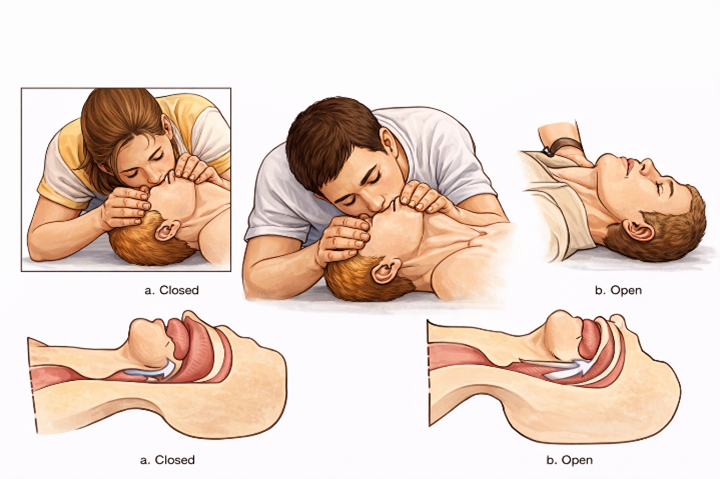
Breathing (Step B): If the patient does not resume adequate, spontaneous breathing promptly after his head has been tilted backward, artificial respiration should be given by the mouth-to-mouth or mouth-to-nose method.
Heart compression (Step C): In attempting to bring back to life a non-breathing person whose heart has stopped beating, heart compression (external cardiac compression) should be applied along with artificial respiration.
Technique for heart compression: Compression of the sternum produces some artificial ventilation, but not enough for adequate oxygenation of the blood. For this reason, artificial respiration is always required whenever heart compression is used.
Checking effectiveness of heart compression: Check the reaction of the pupils. If the pupils contract when exposed to light, this is a sign that the brain is receiving adequate oxygen and blood.
Summary of points to be remembered when applying artificial respiration and heart compression: Don’t delay. Place victim on his back on a hard surface.