
The Fire Triangle is a fundamental concept in fire science that explains the three essential elements required for a fire to exist.
A fire can only start and continue when all three elements are present simultaneously.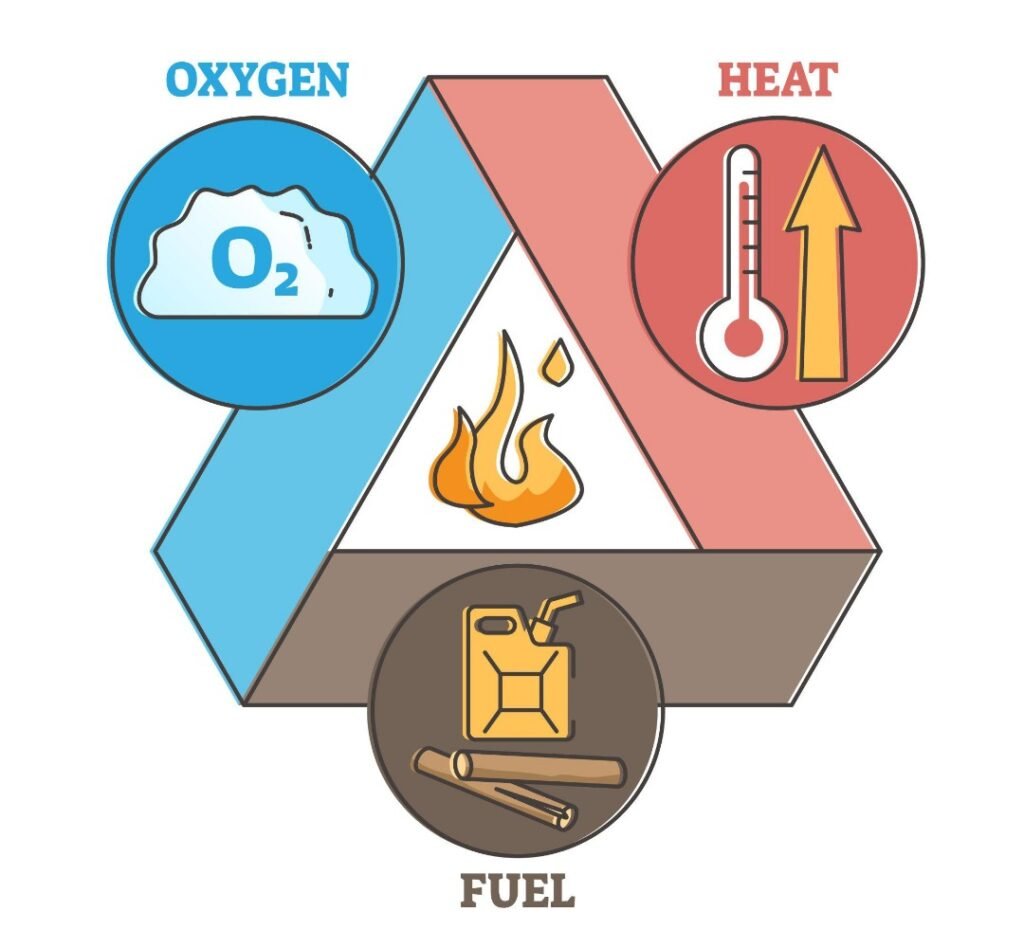
Three Elements of the Fire Triangle
Heat
Heat provides the energy required to ignite and sustain combustion.
Common heat sources on board ships include:
Open flames
Hot surfaces
Electrical equipment
Friction and sparks
Without sufficient heat, ignition cannot occur.
Fuel
Fuel is any material capable of burning.
Examples of fuels on ships:
Solid materials (wood, paper, textiles)
Flammable liquids (oil, fuel, solvents)
Gases (LPG, vapours)
Without fuel, a fire cannot be sustained.
Oxygen
Oxygen supports the combustion process.
Sources of oxygen:
Atmospheric air
Ventilation systems
Oxidizing substances
Without oxygen, combustion is not possible.
Principle of Fire Control
Fire prevention and firefighting are based on breaking the Fire Triangle.
A fire can be extinguished by removing any one of the three elements:
Cooling → Removes Heat
Smothering → Removes Oxygen
Starvation → Removes Fuel
Importance in Fire Fighting
Understanding the Fire Triangle helps crew members:
Identify fire risks
Select appropriate firefighting methods
Apply correct extinguishing techniques
Prevent re-ignition