
Fire extinguishers are portable fire-fighting appliances designed to control or extinguish small fires during their initial stages.
Each extinguisher is developed for specific classes of fire, and correct selection is essential for safe and effective fire control.
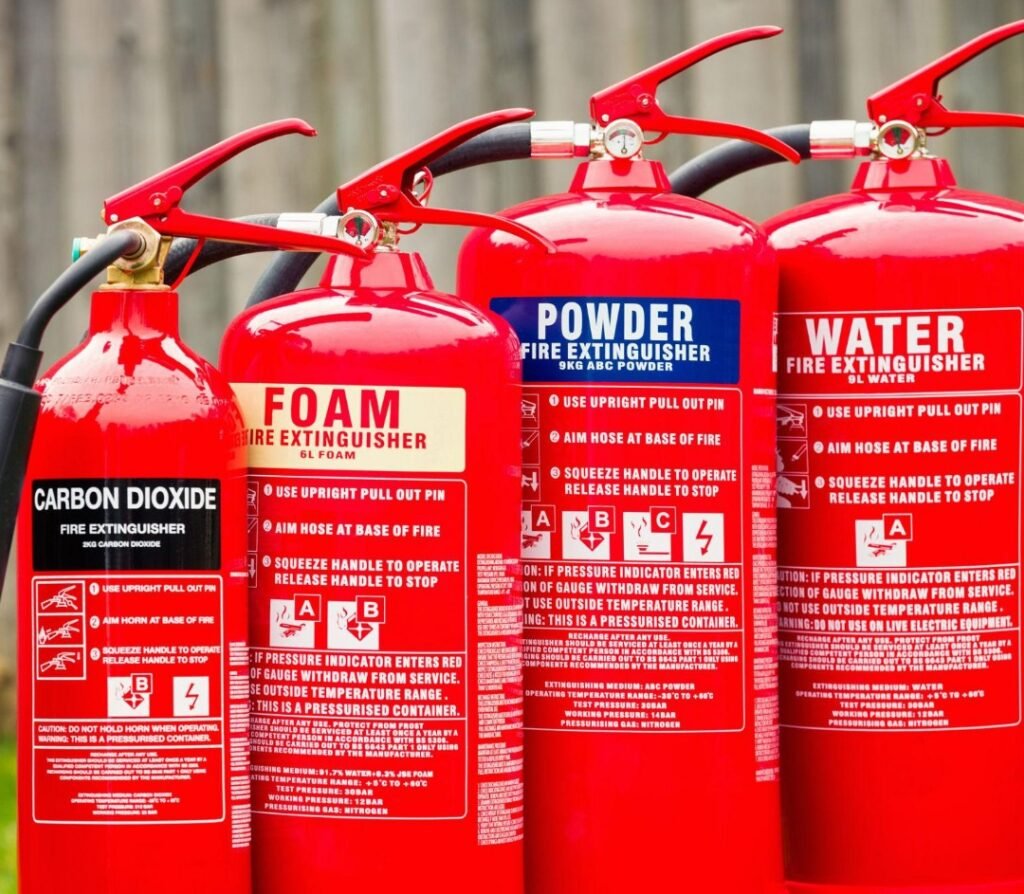
Classification of Fire Extinguishers
Water Extinguisher
Suitable For: Class A fires involving solid combustible materials.
Examples: Wood, paper, textiles, plastics.
Principle of Operation: Extinguishes fire primarily by cooling the burning material and removing heat.
Limitations: Not suitable for flammable liquids or electrical fires.
Foam Extinguisher
Suitable For: Class A and Class B fires.
Examples: Flammable liquids such as oil, petrol, diesel.
Principle of Operation: Forms a foam blanket over the fuel surface, separating oxygen from the fire and suppressing vapours.
Limitations: Use near electrical equipment only if approved.
Dry Powder Extinguisher
Suitable For: Class A, B, C fires and electrical fires.
Examples: Flammable liquids, gases, electrical installations.
Principle of Operation: Interrupts the chemical chain reaction of combustion.
Advantages: Versatile and effective across multiple fire risks.
Carbon Dioxide (CO₂) Extinguisher
Suitable For: Electrical fires and Class B fires.
Examples: Electrical panels, switchboards, machinery.
Principle of Operation: Displaces oxygen and provides localized cooling.
Advantages: Leaves no residue, ideal for sensitive equipment.
Wet Chemical Extinguisher
Suitable For: Class F fires involving cooking oils and fats.
Examples: Galley and kitchen fires.
Principle of Operation: Produces a cooling and smothering effect by forming a protective layer over the burning surface.