Basic knowledge of Ships arrangements of a chemical tanker
Tankers for carrying chemicals. This section deals with the design and arrangements of tankers involved in transportation of chemicals in bulk. It is essential for the further progress of the course that the trainees are familiar with the different types and arrangements of chemical tankers when they have completed this section of the course.
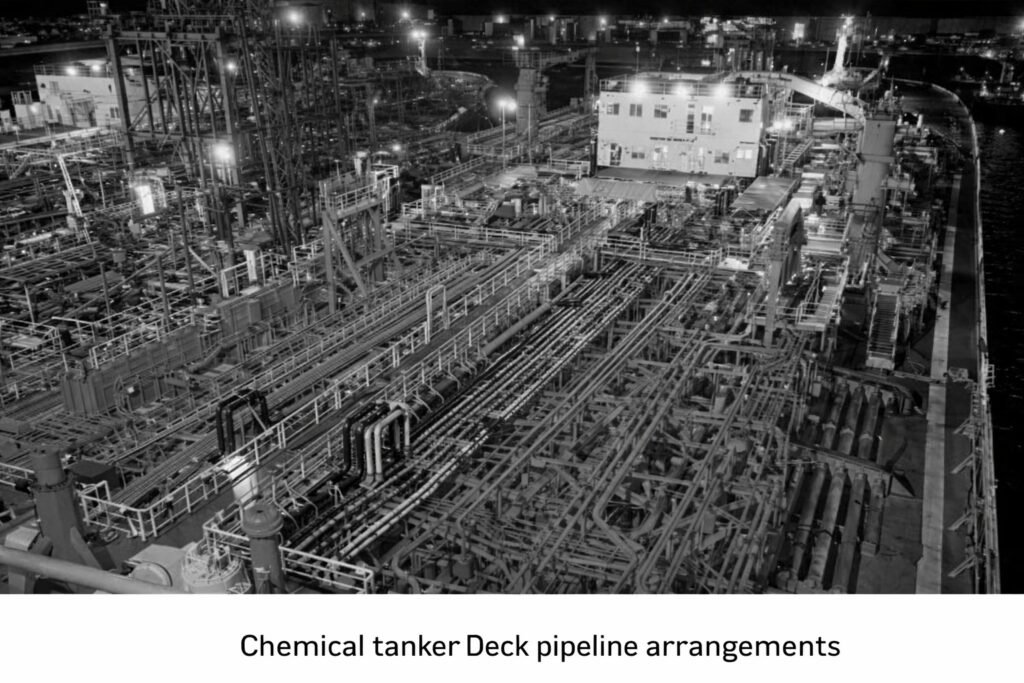
General ship arrangement The purpose of this lecture is to describe general arrangements of a chemical tanker; the essential message is that segregation and separation of cargoes are fundamental to the safety of a chemical tanker. Display diagrams from Appendix 1 fig. 1.4 A and describe the general arrangements of a chemical tankers, its cargo equipment, pipelines and cargo systems.
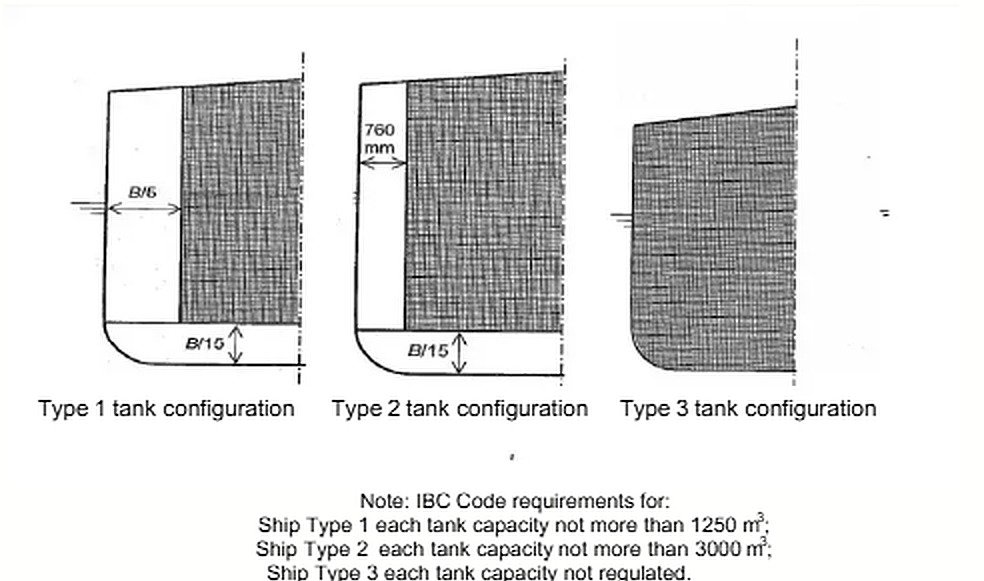
Survival capability and tank location The purpose of this lecture is to explain some of the considerations for the IMO grouping of chemical tankers and the relationship between ship-type requirements and the cargo carried. It is essential to point out that a chemical tanker may have sections of its cargo tanks that provide different degrees of protection.
Cargo equipment and instrumentation Tanks, piping and hoses The purpose of this lecture is to describe generally the different tank types and the cargo area and systems for loading and unloading cargo and ventilating cargo tanks. The ship’s cargo hoses are frequently a part of these systems, and it is therefore important to discuss correct handling of the hoses.
Tank coatings and material of construction The aim of this lecture is to familiarize the trainees with material of construction, coatings of cargo tanks and cargo piping on chemical tankers. It should be emphasized that it is most important that stainless steel and tank coatings are handled correctly and that tank coating guides and maintenance instructions are strictly followed by ship’s personnel.
Pumps and eductors The purpose of this lecture is to describe common types of cargo pump found on chemical tankers. It is also important that the safety aspects concerning the different types and arrangements of pumps are discussed and summarized.
Cargo heating systems The purpose of this lecture is to describe generally the different cargo heating systems. The safety aspects concerning their use should be discussed and summarized.
Tank-washing and slop-retaining systems The purpose of this lecture is to describe generally the tank-washing and slop-retaining systems.
Inert-gas systems The purpose of this lecture is to explain the term ‘inert gas’, to describe the different types and uses of inert gas and to describe the arrangement of an inert-gas generator. It is important to call attention to the composition of inert gas produced in an inert-gas generator and the potential hazards that some of these constituent gases may pose.
Instrumentation The main purpose of this lecture is to describe different gauging devices used in cargo tanks and to explain how the user of the device may be exposed to the cargo vapour. Necessary precautions to avoid this potential hazard should be discussed.
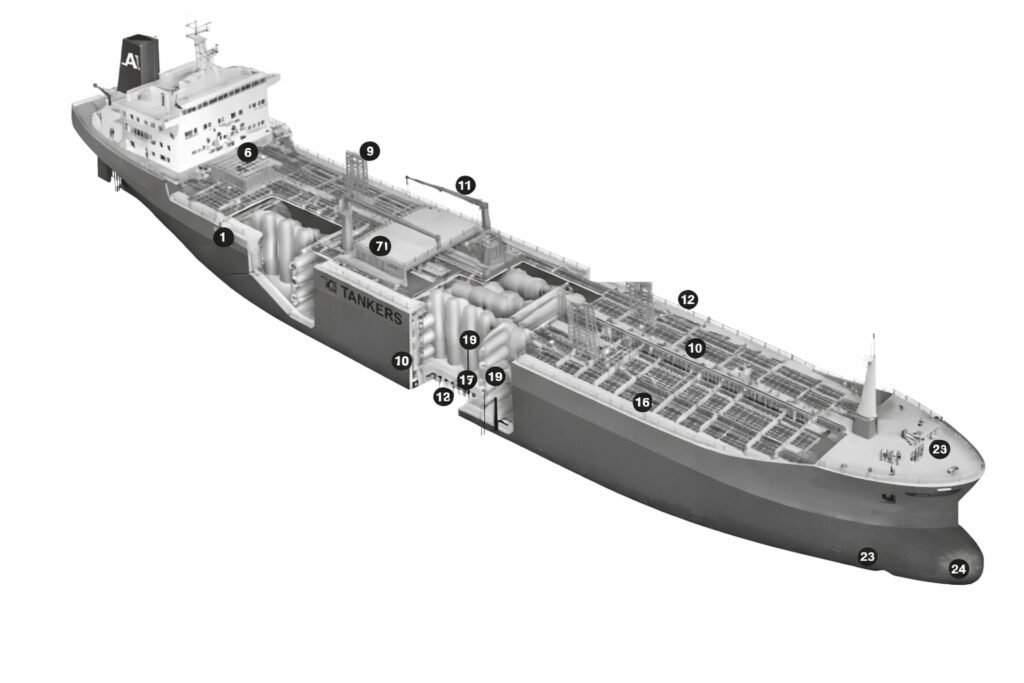
1. Balanced rudder with conventional propeller
2. Auxiliary unit
3. Lifeboat in gravity davits
4. Hydraulic prime mover
5. Cargo control room
6. Tank heating/ tankwash room
7. Cofferdam, empty space between two tanks
8. Vent pipes with pressure-vacuum valves
9. Hydraulic high pressure oil-and return lines for anchor and mooring gear,
10.Hose crane
11. Manifold
12. Wing tank in double hull
13. Double bottom tank
14. Tank-top
15. Longitudinal vertically corrugated bulkhead
16. Transverse horizontally corrugated bulkhead
17. Cargo pump
18. Catwalk
19. Railing
20. Deck longitudinal
21. Deck transverses
22. Cargo heater
23. Forecastle deck with anchor-and mooring gear
24. Bow thruster
25. Bulbous bow