
The Instructors should make use of appropriate check list and conduct exercises using the code of safe working practices for merchant seamen emphasize that no person is permitted to enter any enclosed space as defined (cargo tank, cofferdam, double bottom tank, etc) unless authorized by the Master, who has ensured that the required checks have been carried out before passing these compartments as safe for entry. An enclosed space entry permit must be completed in every case. Pre entry tests must be carried out, any reading of not more than 1% LFL from flammable vapour and 0 ppm for toxic vapour, taken on an approved gas measuring meter, only shall be considered safe for entry. Entry permits may be made for multi cargo tank entries, however, tanks which are not entered and worked within four hours of the initial test, must be retested and a new permit issued. It is therefore advisable to only test smaller groups of tanks at one time, e.g. only test as many as can be worked in a four-hour period. However, at no given time shall a permit be granted for entry into more than six tanks.
Precautions to be Taken When Entering Enclosed Spaces Entry into a space that is not gas free or does not contain 21% Oxygen shall only be permitted in cases of an emergency or for unavoidable operational requirements. (0.25 hours)
The number of persons entering the tanks shall be kept to a minimum required, but will normally be at least two, each wearing the appropriate PPE. A stand by team and additional appropriate PPE equipped with the required rescue equipment shall be available outside the enclosed space in which entry has been made.
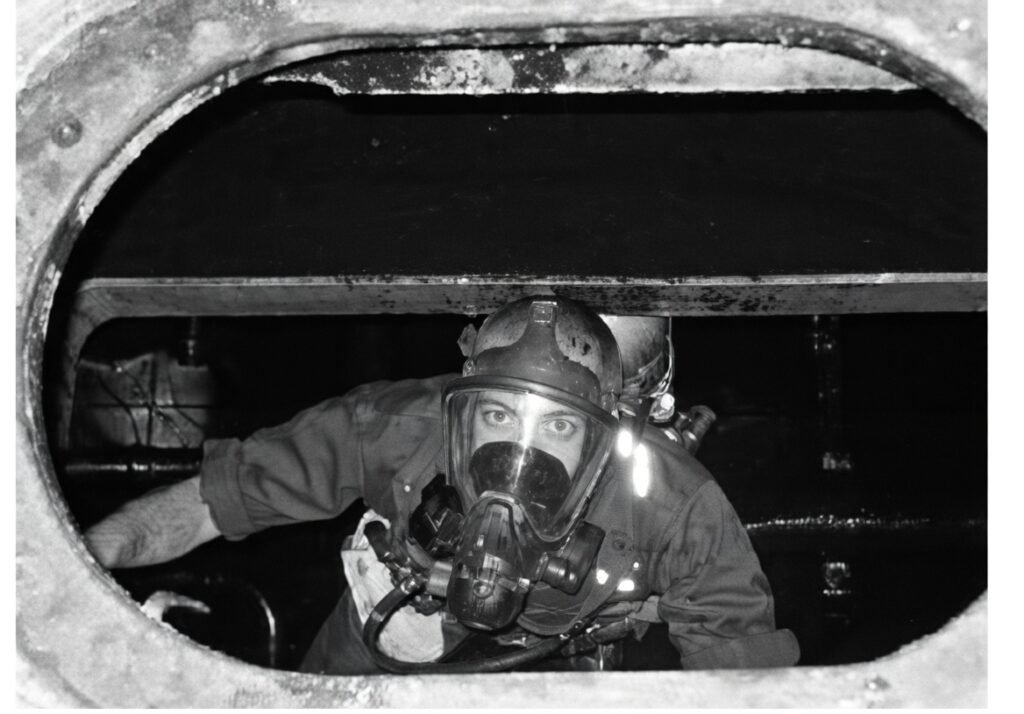
If entry is absolutely required without the tanks being gas free, or with the presence of gas in a tank for operational requirement following shall be completed prior to undertaking such an operation:
- Risk assessment and hazard identification.
- Plan for work including briefing the concerned personnel on the required precautions, proper techniques, PPE requirement & training.
- Emergency response plan shall be prepared in advance and approved by the Master.
- Suitable breathing apparatus, protective clothing and other equipment required for such entry shall be used by the persons entering the tank. (Only persons suitably trained and capable of dealing with any unexpected event that may be encountered in the tank shall be sent for such an entry after making the supporting team stand by on the scene to assist the personnel in an unlikely event of an incident.)
Precautions to be Taken Before and During “Repair and Maintenance” Work in a Gas Dangerous Area (0.25 hours) The use of appropriate PPE is mandatory to protect the crew against the various hazards. Monitoring and evaluation of spaces adjacent to cargo tanks for vapour content must be carried out at regular intervals.
In case of a doubt on the integrity of cargo tank, the adjacent spaces also to be monitored and logged for toxic gases / cargo vapours. If gas concentrations are observed, repairs and maintenance work must be stopped when working in the concerned area. Additionally, the cause of the presence of gas concentration must be investigated into and the same eliminated. Other adjoining spaces must be checked for similar defects.
Safety Measures for Hot and Cold Work (0.25 hours) The Instructors should explain the trainees that the checks carried out for hot and cold work by Officer responsible for Safety are:
- Oxygen is 21% by volume
- tests with a combustible gas indicator show not more than 1% LFL.
- Adequate fire-fighting equipment must be laid out and be ready for immediate use.
- Fire-watch procedures must be established for the area of hot work, and in adjacent, non-inerted spaces where the transfer of heat, or accidental damage, may create a hazard e.g. damage to hydraulic lines, electrical cables, thermal oil lines etc. Monitoring should be continued for sufficient time after completion of hot work.
- Effective means of containing and extinguishing welding sparks and molten slag must be established.
- The work area must be adequately and continuously ventilated. The frequency of atmosphere monitoring must be established. Atmospheres should be re-tested after each break during work periods, and at regular intervals. Checks should be made to ensure there is no ingress of flammable vapours or liquids, toxic gases or inert gas from adjacent or connected spaces.
Electrical Safety Precautions (0.25 hours) The instructors should make the trainees aware that the safety precautions that needs to be ensured are:
- That electrical supply connections are made in a gas free space;
- That existing supply wiring is adequate to carry the electrical current demanded without overloading, causing heating;
- The insulation of flexible electric cables laid across the deck is in good condition;
- The cable route to the worksite is the safest possible, only passing over gas free or inerted spaces; and
- The earthing connection is adjacent to the work site with the earth return cable led directly back to the welding machine.
Ship/Shore Safety Checklist Ship / shore liaison The essential message of this lecture should be that safety regulation, good communication and the best possible co-operation between ship and terminal are fundamental to the safety of personnel and material when alongside a terminal. The routines and responsibilities of personnel on watch should be elucidated and discussed. Information related to this section can be obtained from references B1.