If abandoning the ship requires entering the water, every effort should be made to minimize the risks associated with cold water immersion. Whenever possible, avoid jumping from heights greater than five metres, as the impact with the water can cause serious injury.
Sudden immersion in cold water can produce cold shock, causing an uncontrolled increase in breathing rate. This may lead to water entering the lungs and significantly increase the risk of drowning.
Whenever possible, remain dry by boarding a lifeboat or liferaft directly without entering the water. If jumping into the sea is unavoidable, keep your elbows close to your body, cover your nose and mouth with one hand, and use the other hand to hold your wrist or elbow firmly to reduce the impact. Avoid landing on the canopy of an inflatable liferaft, and if the ship is still moving forward, enter the water astern of the liferaft.
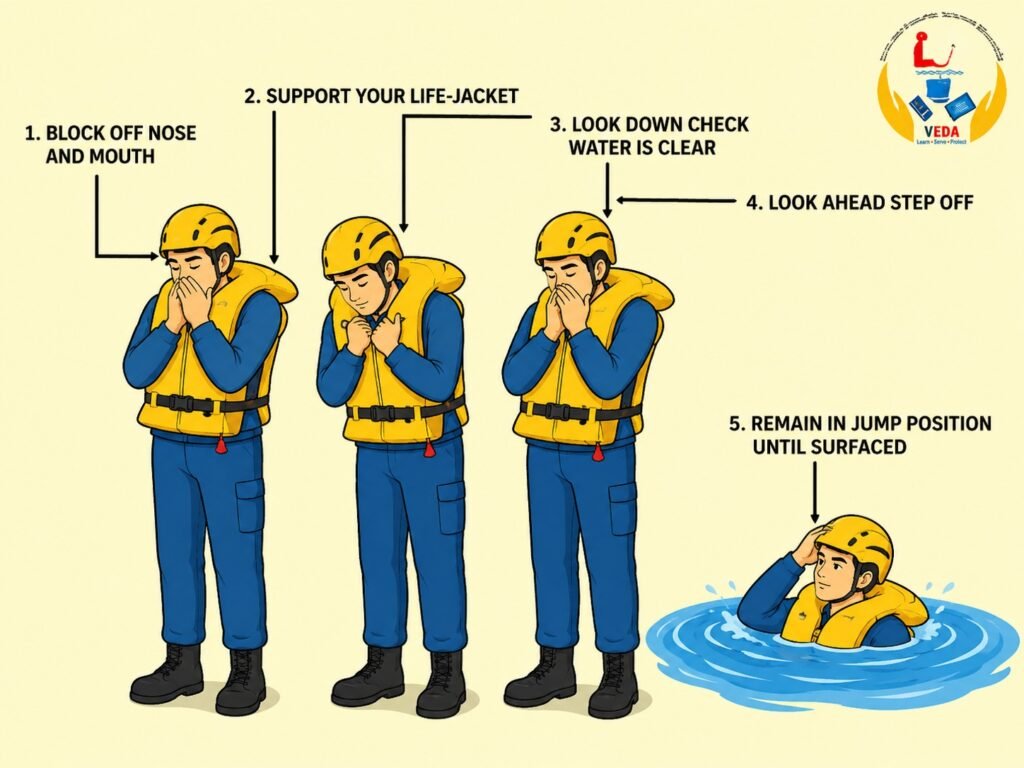
No one should enter the water without wearing a properly secured lifejacket. If available, an immersion suit or thermal protective aid should also be worn to reduce heat loss and increase survival time. Even in moderately cold water, body temperature decreases rapidly without adequate protection.
If there was insufficient time to prepare before entering the water, immediately fasten all clothing, activate personal signal lights, locate your whistle, and secure any other survival equipment. Although severe shivering and pain are normal responses to cold water, they are not immediately dangerous. However, these reactions reduce hand movement quickly, making it important to complete essential preparations without delay.
While floating in the water, avoid unnecessary swimming unless it is required to reach a nearby lifeboat, another survivor, or floating debris that can provide additional buoyancy. Excessive movement consumes valuable energy and accelerates body heat loss, increasing the risk of hypothermia.
Survivors should conserve energy by remaining as still as possible. Swimming unnecessarily circulates warm blood from the body’s core to the arms and legs, causing rapid heat loss. It also removes the thin layer of relatively warmer water trapped between the clothing and the body, further increasing cooling.
The position adopted while floating in the water is extremely important for conserving body heat. Survivors should float quietly with their legs together, elbows close to their sides, and arms folded across the front of the lifejacket. This position minimizes the body’s exposure to cold water. The head and neck should be kept above the water whenever possible. Survivors should board a lifeboat, liferaft, or any floating object at the earliest opportunity to reduce immersion time and significantly improve their chances of survival.
Survival in the Water
Survival after abandoning a ship depends greatly on how quickly and safely survivors can enter a survival craft. Whenever possible, personnel should board a lifeboat or liferaft directly from the ship without entering the water. Entering the water before reaching a survival craft exposes a person to several serious dangers that can significantly reduce the chances of survival.
One of the primary disadvantages of entering the water is the rapid loss of body heat. Wet clothing and prolonged exposure to cold water can quickly lead to hypothermia, reducing a person’s physical strength and ability to survive. In addition, climbing into a lifeboat or liferaft from the water requires considerable physical effort. Survivors may become exhausted or even require assistance from others already inside the survival craft. Water-soaked clothing also becomes heavy and uncomfortable, increasing fatigue and making movement more difficult.
For these reasons, every effort should be made to board the survival craft directly whenever possible, avoiding unnecessary exposure to the sea.