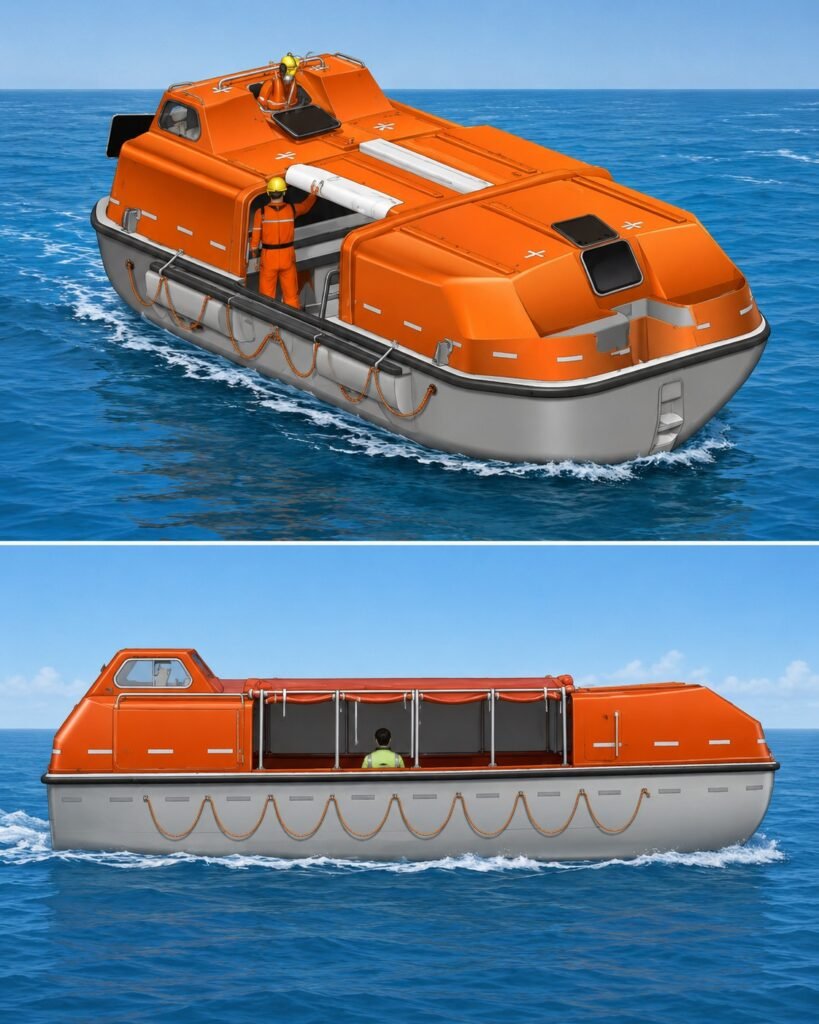
Partially enclosed lifeboats provide a combination of protection and accessibility. They are fitted with permanently attached rigid covers extending over at least 20 percent of the length of the bow and 20 percent of the stern. In addition, they are equipped with a permanently attached foldable canopy that, together with the rigid covers, completely encloses the occupants.
This weatherproof enclosure protects survivors from wind, rain, sea spray, sunlight, and other environmental hazards while still allowing the lifeboat to be operated efficiently during rescue operations.
Launching Arrangements
Launching arrangements are an essential part of a ship’s life-saving system. They are designed to ensure that lifeboats, liferafts, and rescue boats can be launched quickly, safely, and efficiently during emergency situations. These arrangements must comply with the requirements of the SOLAS Convention and the International Life-Saving Appliance (LSA) Code to provide maximum protection for everyone onboard.
For cargo vessels of 20,000 Gross Registered Tons (GRT) and above, lifeboats must be capable of being launched even while the vessel is still making headway at a speed of up to 5 knots in calm water. A painter line may be used to maintain the connection between the lifeboat and the ship until it is safe to release. Rescue boats on all ships must also be capable of being launched under similar operational conditions to ensure rapid response during emergencies.
On passenger ships, all survival craft must be launched within 30 minutes from the time the abandon ship signal is given. For cargo ships, the launching time is reduced to 10 minutes, reflecting the smaller number of persons onboard and the need for faster evacuation.
Lifeboats must be capable of being safely lowered into the water while carrying their full approved complement of passengers and crew. They must also be capable of being hoisted back onto the ship at a specified speed while carrying at least two persons. Rescue boats must be capable of being recovered with either their full rescue crew or six persons, whichever number is greater.
International regulations specify both the minimum and maximum lowering speeds for survival craft. In most systems, the maximum lowering speed is controlled by a centrifugal brake fitted to the launching winch, ensuring that the descent remains smooth and controlled.
For partially enclosed lifeboats, the davit system must include a span wire fitted with at least two lifelines to provide additional safety during boarding and launching.
Every launching system must include an efficient manual recovery mechanism. This hand-operated gear serves as a backup in case the power-operated system becomes unavailable. Powered winches must also be equipped with automatic cut-off devices to prevent excessive tension in the falls when the davit arms reach their operating limits.
The launching and recovery system must be designed so that one trained person can operate it either from the ship’s deck or from inside the survival craft. When operated from the deck, the operator must always have a clear and unobstructed view of the lifeboat or rescue boat throughout the launching process.