A Hydrostatic Release Unit (HRU) is an essential safety device fitted to inflatable liferafts to ensure that they automatically float free and inflate if a ship sinks before the crew can manually launch them.
A liferaft equipped with an HRU performs two important functions:
- It automatically floats free from the sinking vessel.
- It inflates automatically without requiring human intervention.
This automatic operation is achieved through the Hydrostatic Release Unit, which activates when submerged beneath approximately 4 metres (13 feet) of water.
As the vessel sinks, increasing water pressure activates the HRU. The device contains a specially designed knife or chisel mechanism that cuts the securing strap holding the liferaft container to the ship.
Once released, the liferaft container rises toward the surface because of its inherent buoyancy. The painter line remains attached to the ship by a specially designed weak link.
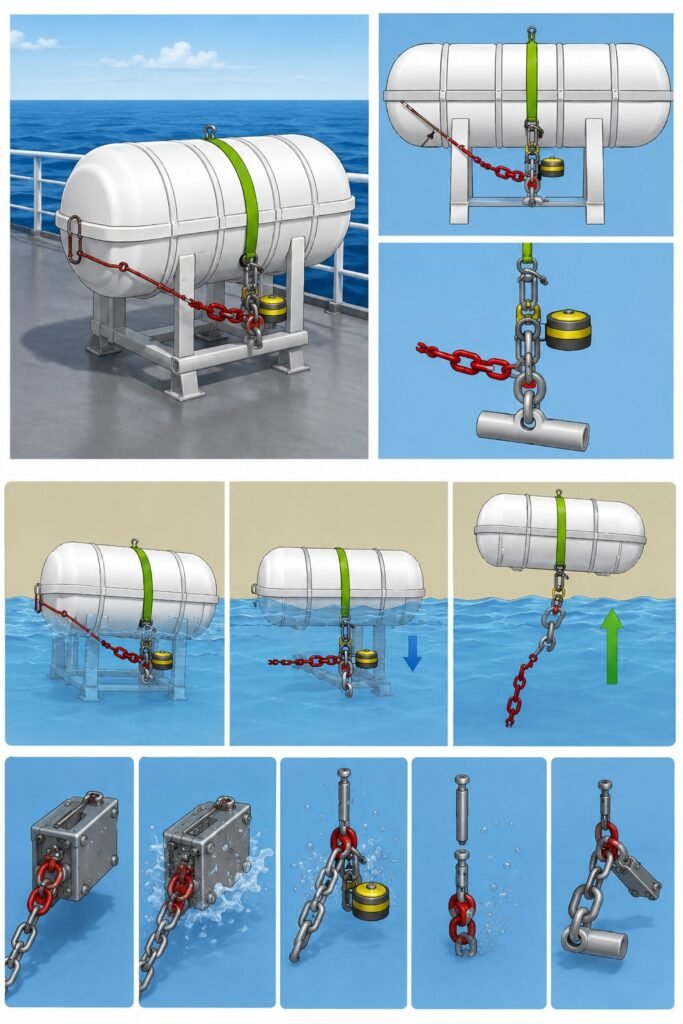
As the painter becomes fully extended, it activates the gas inflation cylinder inside the container, causing the liferaft to inflate automatically.
After inflation, the buoyant force exerted by the inflated liferaft becomes greater than the breaking strength of the weak link. The weak link then breaks, allowing the fully inflated liferaft to float freely on the water, ready for survivors to board.
According to international standards, the approved weak link should separate when subjected to a force of between 1.8 kN and 2.6 kN. Improvised ropes or ordinary lines must never be used as substitutes because they do not provide the required breaking strength.
Some liferaft systems contain multiple ropes extending from the container, including separate firing lines, painter lines, and bowsing lines. In such cases, the manufacturer’s instructions should always be consulted to correctly identify each line before operation.