The removal of a sick or injured person, either from the site of an accident or ashore, is extremely important, as the person’s life may depend on the arrangements made. This is especially critical if the casualty has spinal injuries, a heart condition, or a severe fracture, all of which are often accompanied by shock. Therefore, handle the casualty with utmost care, reassure them, clearly understand the nature of the injury, and use sound judgment.
Unless there is immediate danger from fire, explosion, or toxic substances, do not move the casualty until:
- suspected fractures have been immobilized; and
- severe bleeding has been controlled.
After this, plan the best route for transport. Lift the casualty gently and carry them smoothly, remembering that every jolt causes unnecessary pain.
The method of transport will depend on the casualty’s condition and the nature of the injury.
If the ship is in port, it is usually best to wait for an ambulance, as the personnel are trained in handling casualties. You may assist them and provide relevant information. For example, if a patient has fallen into a hold, the best method is to lower a stretcher, administer first aid, place the casualty on a hatch cover or similar platform, and lift them using the ship’s crane. This can be frightening for the casualty, so reassurance is important. The person in charge may stand astride the stretcher on the hatch cover, maintaining balance by holding the guy wires.
Similarly, if the casualty is on deck and the gangway is narrow or unstable, it may be less distressing to lower them over the side using a hatch cover or similar support.
Manhandling
Manual handling may be possible in some situations. Two helpers may carry the casualty, each supporting the back and shoulders with one arm and the thighs with the other hand. If conscious, the casualty may assist by holding onto the helpers’ shoulders.
The piggyback method is suitable only if the casualty is conscious and able to hold on securely.
In narrow spaces, a fore-and-aft carry may be more appropriate. One helper supports the casualty under the arms, while the other supports the knees.
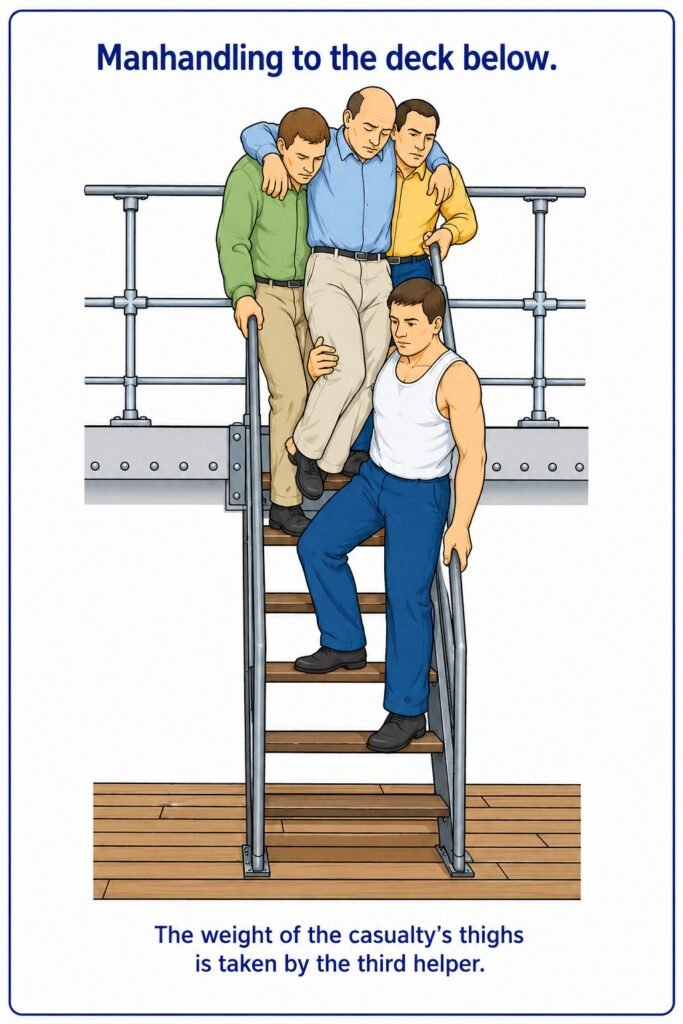
Other methods of manual handling may also be used. One advantage of the three-handed seat is that one helper has a free arm to support an injured limb or provide back support. The choice of which helper has the free arm depends on the injury.
As a last resort, the drag-carry method may be used in confined spaces, especially where debris is present. One rescuer may need to reach and remove a trapped casualty. Later, two rescuers may continue moving the casualty. Care must be taken to ensure that tied wrists do not interfere with the rescuer’s breathing apparatus.
Neil-Robertson stretcher
Various modified versions of this stretcher exist.
It is a highly effective general-purpose stretcher used on ships. It provides firm support, is easy to carry, and is particularly useful in narrow spaces, around tight corners, or when hoisting is required. It is made of strong canvas reinforced with bamboo slats.
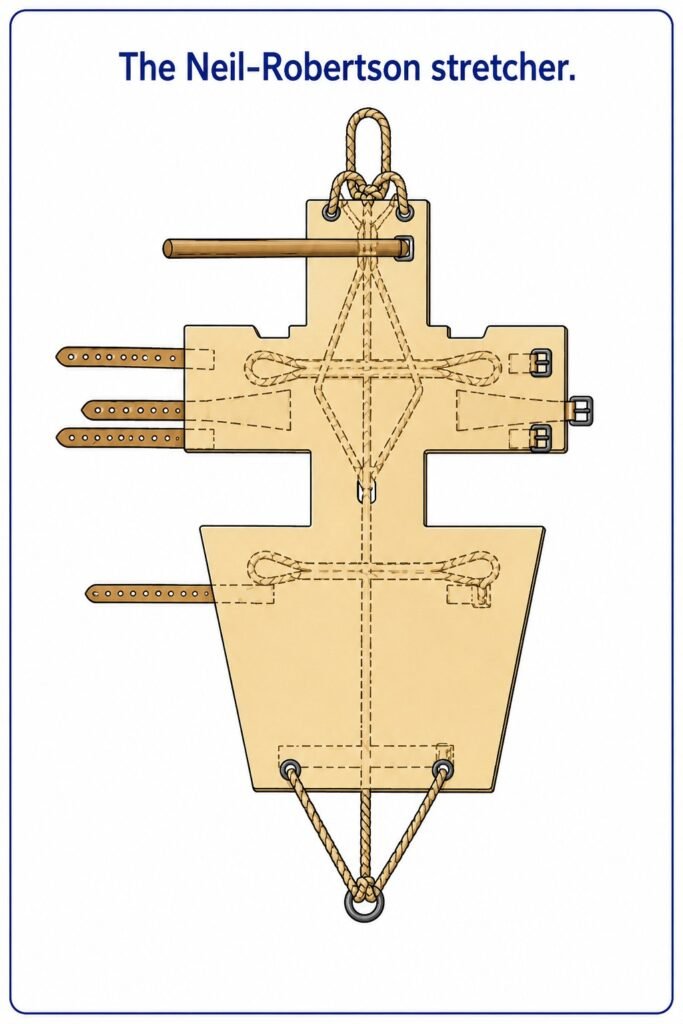
The upper section supports the head and neck, secured with a forehead strap. The middle section wraps around the chest, with notches for the armpits and straps to secure the body. The lower section supports the hips and legs down to the ankles.
If the patient is unconscious, place them on their back and secure the ankles and feet with a figure-of-eight bandage, the knees with a broad bandage, and the wrists together.
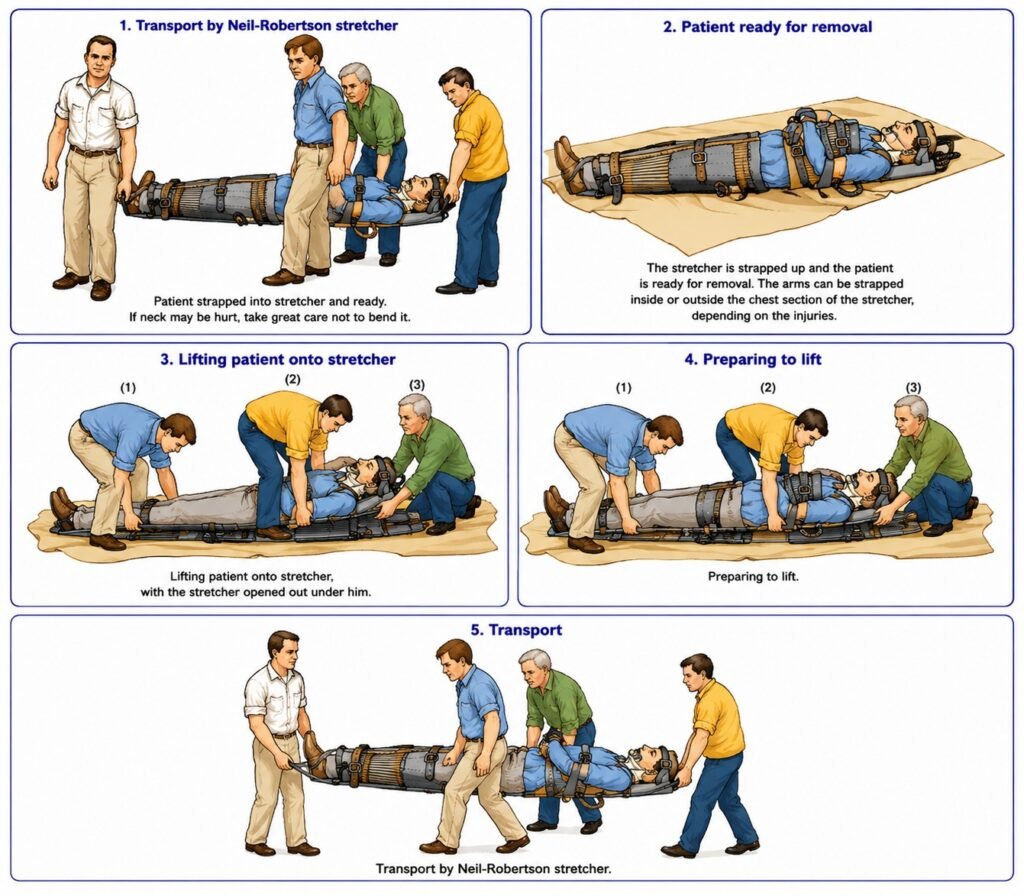
Three rescuers are required:
- No. 1 stands at the legs and supports them.
- No. 2 stands at the chest and supports the torso.
- No. 3 positions the arms around No. 2’s neck and supports the head if unconscious.
Position the stretcher near the patient’s head with straps open. If a spinal injury is suspected, extreme care must be taken.
On command, lift the patient while the stretcher is placed underneath. Then lower the patient carefully. Secure all straps, and the casualty is ready for transport, preferably with four bearers.
This stretcher may also be used for vertical lifting.