
Examination
Eye injuries may result from foreign bodies, blows, cuts, chemicals, or burns, and must always be treated with care due to the sensitivity of the eye. A full history of the injury should first be recorded, including how it occurred and the symptoms experienced. The examination is best performed with the patient lying down, with the head supported and slightly tilted back.
Proper examination requires good lighting, a magnifying glass, tissues, moist cotton swabs, fluorescein strips, anaesthetic eye drops, and antibiotic eye ointment. The tissues around the eye should first be inspected for swelling or bruising. The eye itself should then be examined systematically, including the sclera, conjunctiva, and cornea, comparing both eyes where possible.
The eyelids may need to be gently pulled or turned inside out to inspect the inner surfaces. The cornea should be examined carefully for clarity, as any cloudiness or foreign body indicates injury. Fluorescein staining helps identify damage, as injured areas will appear green under light.
Types of Eye Injuries and Treatment
A blow to the eye, commonly known as a “black eye,” may cause internal damage such as retinal detachment or bleeding. If vision worsens, the patient should be kept at rest and medical advice sought immediately. Even without vision problems, medical review is recommended.
Corneal abrasions are scratches on the eye surface that cause pain and a sensation of something being present in the eye. These are identified using fluorescein staining and treated with antibiotic ointment and an eye pad for 24 hours, with daily re-examination until healing occurs.
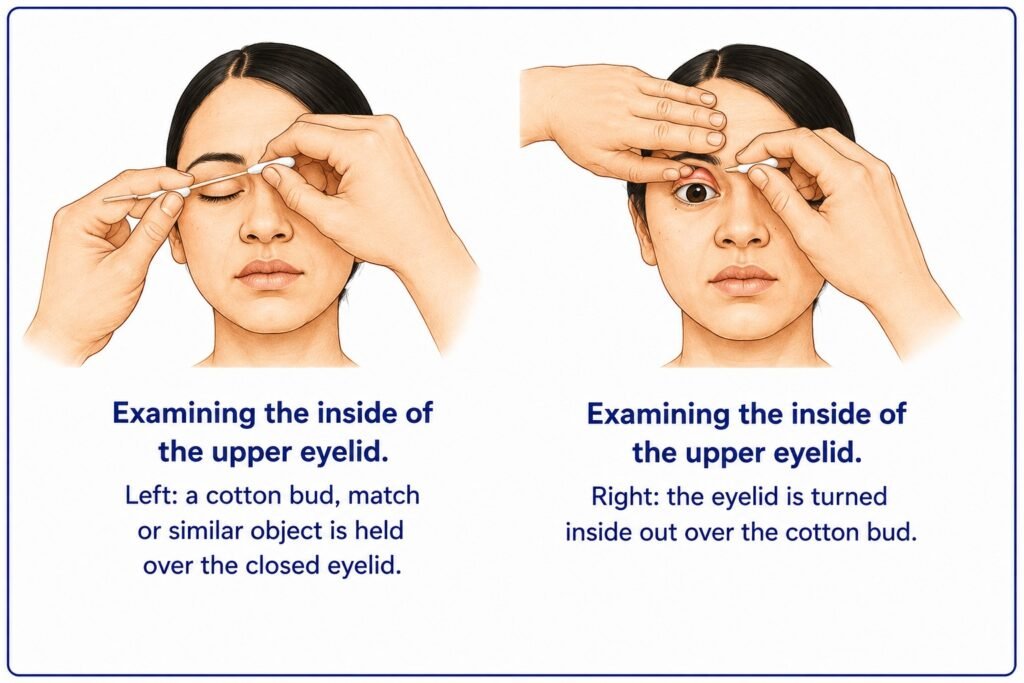
Loose foreign bodies can often be removed gently using moist cotton. After removal, the eye should be examined again and treated if any abrasion is present. If the foreign body is on the cornea, only one careful attempt should be made to remove it after applying anaesthetic drops. If unsuccessful, no further attempts should be made, and the patient should be referred to a doctor.
Embedded or penetrating foreign bodies are more serious and should not be removed. The eye should be treated as for abrasion and the patient referred urgently to a specialist.
Cuts to the eyelids or eyeball require immediate medical advice. The eye should be covered with sterile dressings and kept closed to prevent further damage.
Chemical burns must be treated immediately by washing the eye thoroughly with large amounts of water for at least 10 minutes. After cleaning, the eye should be examined and treated with ointment and protective dressing. Severe cases require urgent medical attention.
Arc eye, caused by exposure to ultraviolet light during welding, leads to pain, redness, and sensitivity to light. Treatment includes cold compresses, dark glasses, and antibiotic ointment if necessary. The condition usually resolves within 48 hours, but further exposure should be avoided.