
The causes of unconsciousness are many and are often difficult to determine. Treatment varies depending on the cause, but in first aid it is usually not possible to diagnose the cause, let alone provide specific treatment.
The immediate threats to life may be:
- Breathing obstructed by the tongue falling back and blocking the throat.
- Stopped heart.
Breathing
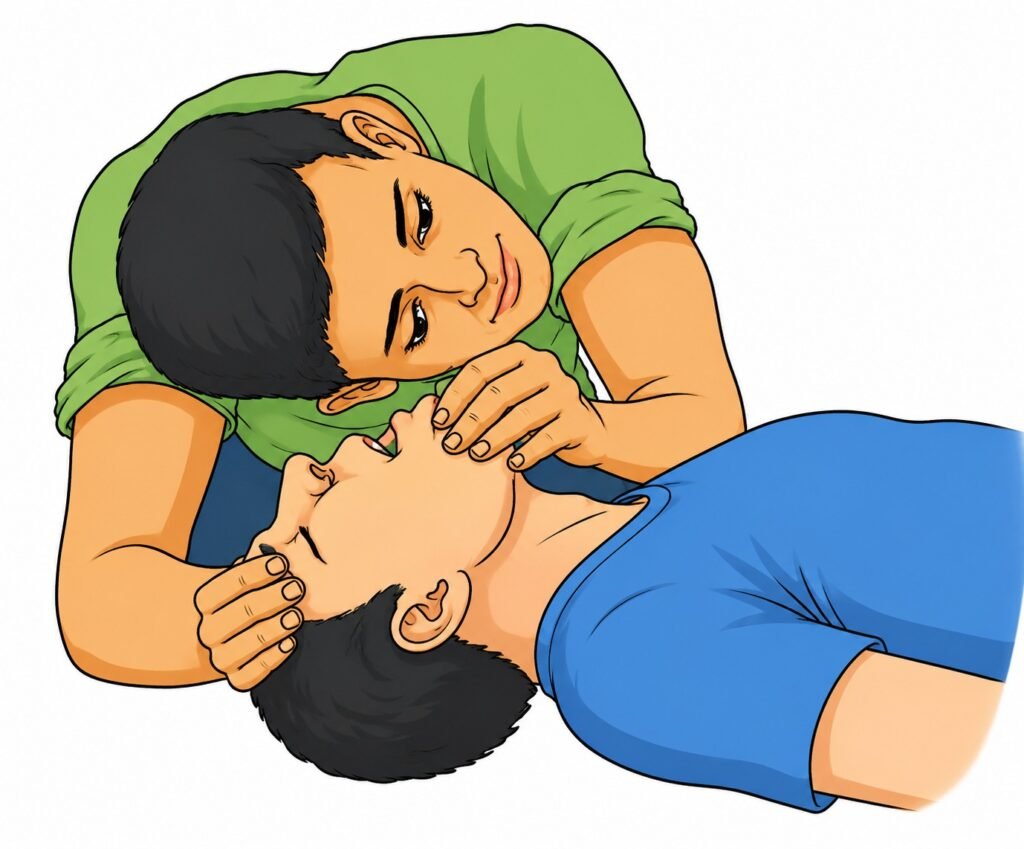
With an unconscious patient, first listen for breathing. To relieve obstructed breathing, tilt the head firmly backward as far as possible.
Listen and feel for any movement of air, because the chest and abdomen may move in the presence of an obstructed airway without actually moving air. The rescuer’s face should be placed within 2–3 cm of the patient’s nose and mouth so that any exhaled air can be felt against the cheek. Also observe the rise and fall of the chest and listen for exhaled breath.
Remove the patient’s dentures, if any.
Heart
Next, listen for heart sounds. Feel the pulse at the wrist and neck.
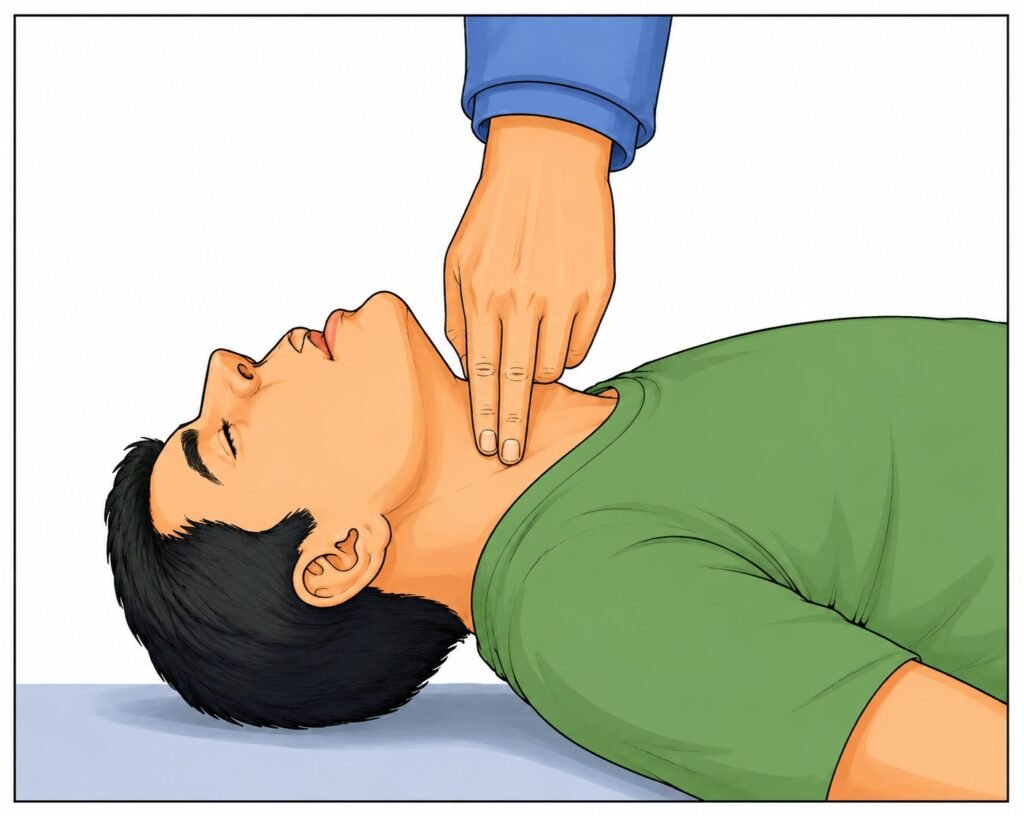
Quickly check the carotid (neck) pulse by placing the tips of two fingers of one hand into the groove between the windpipe and the large muscle at the side of the neck.
The carotid pulse is normally strong; if it cannot be felt or is weak, circulation is insufficient.
Check the pupils of the eyes to see whether they are dilated or constricted. When the heart stops beating, the pupils begin to dilate within 45–60 seconds. They remain dilated and do not react to light (see Physical examination (eyes)).
The examination for breathing and heart action should be performed as quickly as possible. The rescuer must immediately determine whether the casualty:
- Is not breathing and the heart has stopped, or
- Is not breathing but the heart has not stopped.
Not breathing, heart stopped
A trained first aider must begin heart compression immediately. Unless circulation is restored, the brain will be deprived of oxygen and death will occur within 4–6 minutes.
Lay the casualty on a hard surface.
Start heart compression at once. Provide artificial respiration, since breathing stops when the heart stops.
The required aid can be given by one person alternating between heart compression and filling the lungs with air, or preferably by two people working together.
Not breathing, heart not stopped
Open the mouth and ensure the airway is clear.
Begin ARTIFICIAL RESPIRATION immediately.
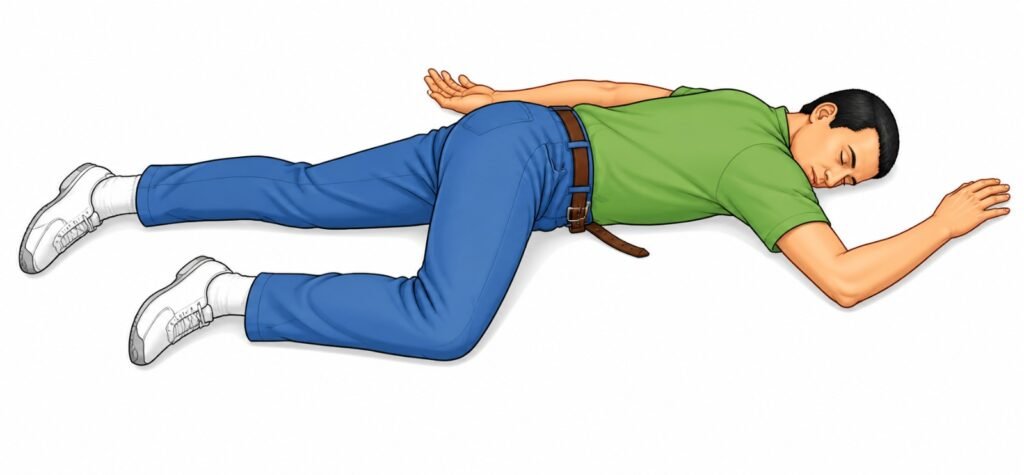
If the heart is beating and breathing is restored, and the casualty is still unconscious, place the casualty in the UNCONSCIOUS POSITION.
Turn the casualty face down, with the head to one side. Do not place any pillows under the head. Pull up the leg and arm on the side toward which the head is facing. Then lift the chin. Stretch the other arm out as shown.
Follow other general principles of first aid