
The human body contains approximately 5 litres of blood. A healthy adult can lose up to half a litre of blood without harmful effects, but losing more than this can be life-threatening.
- Haemorrhage from major blood vessels in the arms, neck, and thighs may occur so rapidly and extensively that death can occur within a few minutes. Bleeding must be controlled immediately to prevent excessive blood loss.
- Bleeding may occur externally following an injury to the outside of the body, or internally from an injury in which blood escapes into tissue spaces or body cavities.
- The signs and symptoms of excessive blood loss include: weakness or fainting; dizziness; pale, moist, and clammy skin; nausea; thirst; a fast, weak, and irregular pulse; shortness of breath; dilated pupils; ringing in the ears; restlessness; and anxiety. The patient may lose consciousness and stop breathing. The number and severity of symptoms generally depend on how quickly and how much blood is lost.
- Once the bleeding has been controlled, the patient should be placed in a reclining position, encouraged to lie still, and treated for shock.
- Fluids should not be given by mouth if internal injury is suspected.
Control
Bleeding may be controlled by direct pressure, elevation, and pressure at pressure points. A tourniquet should be used only when all other methods fail to control severe bleeding.
Direct pressure
The simplest and preferred method of controlling severe bleeding is to place a dressing over the wound and apply direct pressure to the bleeding site using the palm of the hand. Ideally, a sterile dressing should be used; otherwise, the cleanest available cloth should be applied. If no dressing or cloth is available, the bare hand may be used until one becomes available.
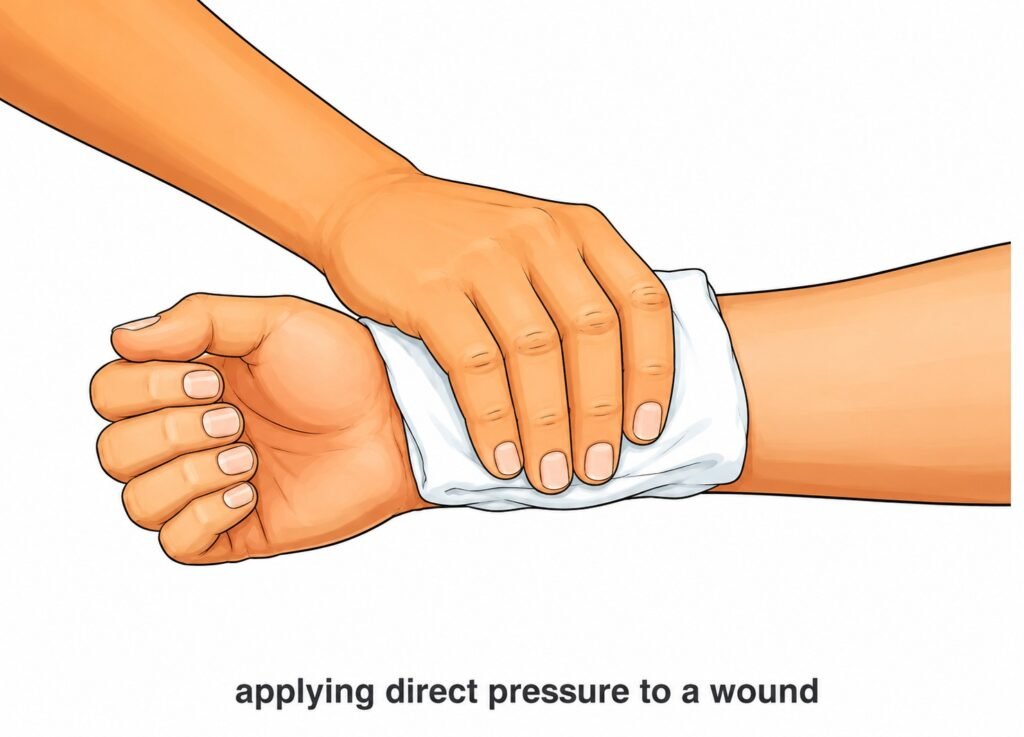
- If the dressing becomes soaked with blood, another dressing should be placed over the first, applying firmer pressure. The original dressing should not be removed, as this may disturb the clotting process.
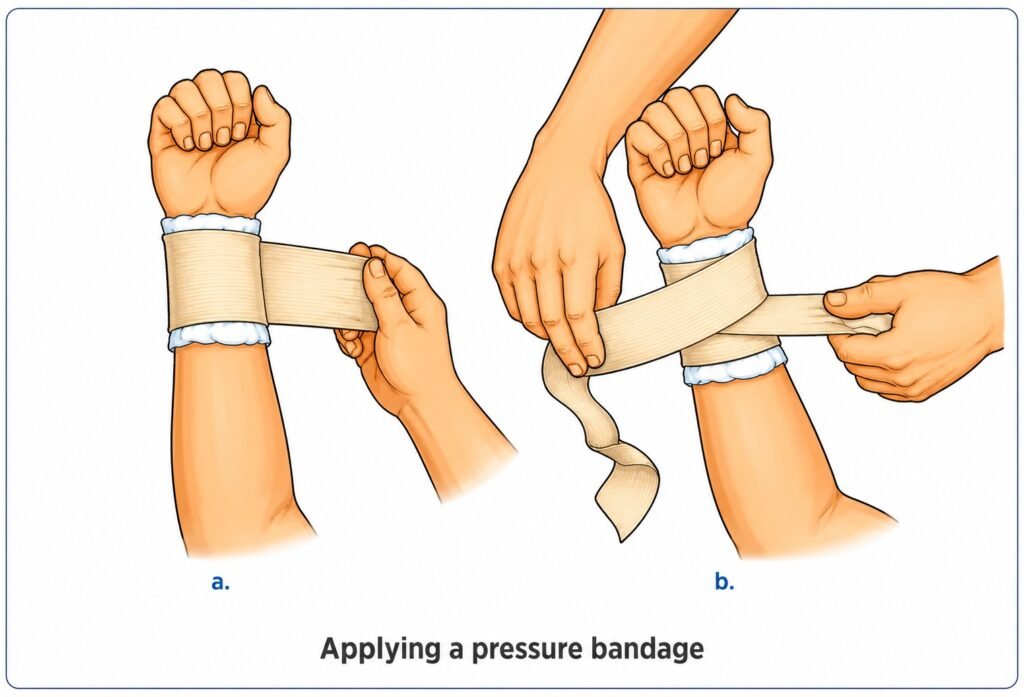
- A pressure bandage may be applied over the dressing to hold it in place. The bandage should be tied firmly enough to provide additional pressure, but not so tight as to stop circulation. A pulse should still be felt beyond the injured area, away from the heart. If the bandage is applied correctly, it should remain undisturbed for at least 24 hours. If the dressings are not soaked with blood and circulation beyond the dressing is adequate, they may remain in place for several days without being changed.
Elevation
In cases of severe bleeding from a limb or the head, direct pressure should be applied to a dressing over the wound while elevating the affected part. Elevation reduces blood pressure in the injured area and helps decrease blood flow.
Pressure points
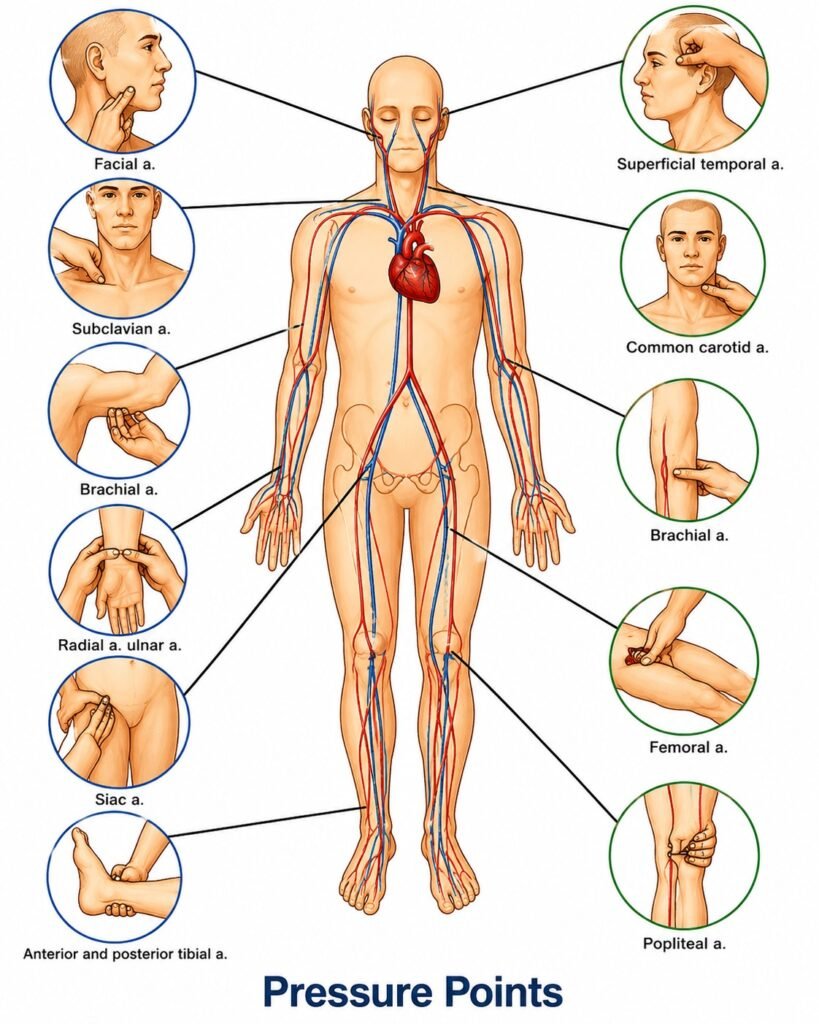
If direct pressure and elevation fail to control severe bleeding, pressure should be applied to the artery supplying the affected area. Since this method reduces circulation below the pressure point, it should be used only when absolutely necessary and only until the bleeding decreases.
- There are several points where pressure may be applied, but the most effective are the brachial artery in the upper arm and the femoral artery in the groin.
- The pressure point for the brachial artery is located midway between the elbow and the armpit on the inner side of the arm, between the large muscles. To apply pressure, one hand should encircle the patient’s arm, with the thumb on the outside and the fingers on the inside. Pressure is applied by pressing the fingers and thumb toward each other.
- The pressure point for the femoral artery is located on the front of the upper thigh, just below the midpoint of the groin crease. Before applying pressure, the patient should be laid on their back. Pressure should be applied using the heel of the hand while keeping the arm straight.
Tourniquet
A tourniquet should be used to control bleeding only when all other methods have failed. Unlike direct pressure, a tourniquet completely stops blood circulation beyond the point of application. This can lead to tissue damage due to lack of oxygen, possibly resulting in the need for amputation.
- Releasing a tourniquet periodically can cause renewed bleeding and increase the risk of shock. If the tourniquet is too tight or too narrow, it may damage muscles, nerves, and blood vessels; if too loose, it may worsen blood loss. There have also been cases where tourniquets were applied and then forgotten. If a tourniquet is used to save a life, immediate RADIO MEDICAL ADVICE must be obtained.
- A tourniquet should be improvised using a wide band of cloth. It can be made from a folded triangular bandage, clothing, or similar material.
- It should be applied and secured using a rigid object such as a piece of wood. The time of application must be recorded. If the casualty is being sent to a hospital, a note indicating the time should be attached to their clothing or limb.
Note
Never cover the tourniquet with clothing or bandages, and do not conceal it in any way. Never loosen the tourniquet unless instructed to do so by a physician.