
Dislocations
Dislocations most commonly affect the shoulder and finger joints. If medical assistance is not available within a few hours, these may be reduced carefully. All other dislocations should be managed by a doctor. Until then, the patient should be kept comfortable and given pain relief. It is important to remember that a dislocation may sometimes be associated with a fracture.
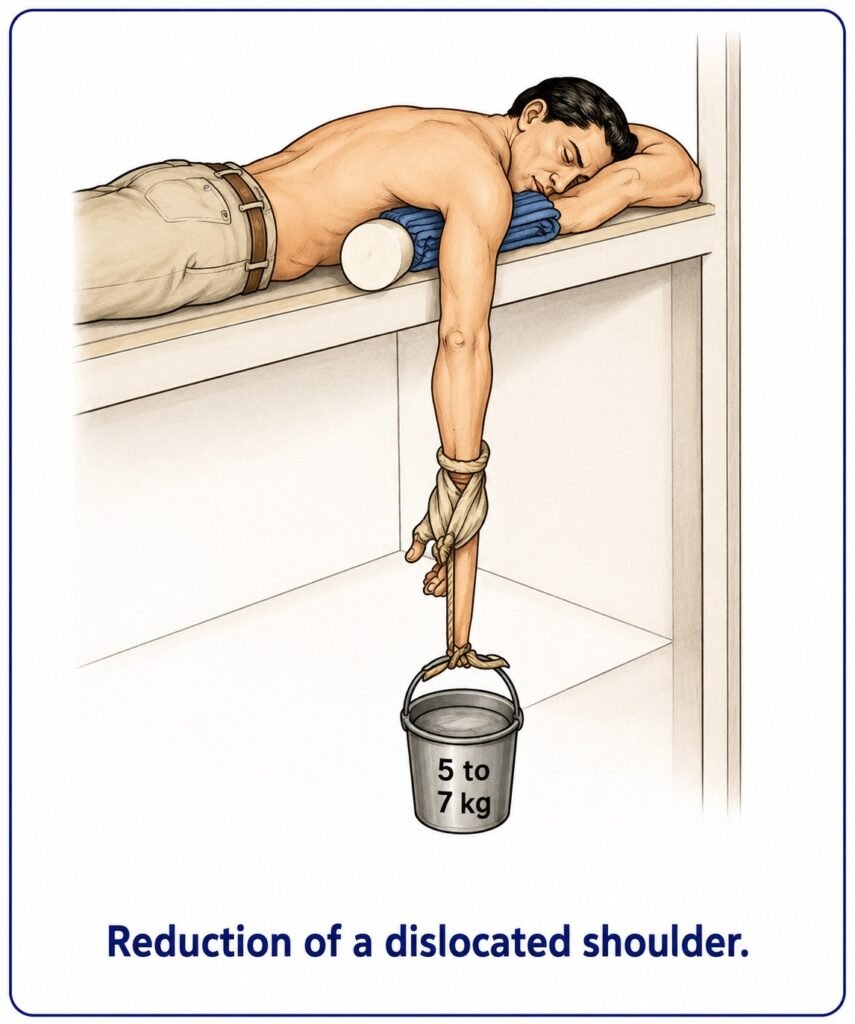
A dislocated shoulder is characterized by severe pain and inability to move the joint. On examination, the normal rounded contour of the shoulder may appear flattened, and the arm may seem longer on the affected side. Pain relief, such as morphine, should be given before attempting reduction. The patient should lie face down with the affected arm hanging freely. The weight of the arm may gradually overcome muscle spasm and allow the joint to return to its normal position. If this does not occur, gentle traction with added weight may be used. After reduction, the arm should be supported in a sling until comfortable, followed by gradual movement and later confirmation with an X-ray.
Dislocated fingers
Dislocated fingers can often be treated by firm and steady traction. While one person stabilizes the arm, the finger is gently pulled to separate the joint surfaces and then guided back into position. After reduction, the injured finger should be strapped to a neighboring finger for support. Movement should begin after about 24 hours, and an X-ray should be performed later to confirm proper alignment.